Páginas

Showing posts with label explanation. Show all posts

2012/11/27

FUTURE TENSES


  Here you have a revision on what we have said in class, the difference between WILL and GOING TO and the use of the FUTURE PERFECT and the FUTURE CONTINUOUS, as well as some examples.


If you want to practise a bit, have a look at this website and you'll find several exercises.

2012/09/26

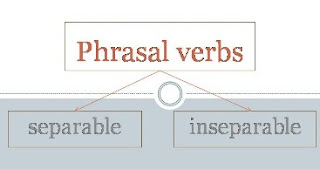
TYPES OF PHRASAL VERBS


Separable
When phrasal verbs are transitive (that is, they have a direct object), we can usually separate the two parts. For example, "look up" is a separable phrasal verb. We can say: "look up the word" or "look the word up".
However, if the direct object is a pronoun, we have no choice. We must separate the phrasal verb and insert the pronoun between the two parts:
Look up the word.
Look the word up.
Look it up. (It's incorrect to say: Look up it).

Inseparable:
However, if phrasal verbs are intransitive (that is, they don't have a direct object), we can't separate them.
Ex: I want my marks to go up.

Sometimes it's not easy to know whether they are separable or inseparable. If you are not sure, use a noun (or noun phrase) and don't separate the phrasal verb. You'll be always right that way! ;)

Here you have a website where you can look up the definition of the phrasal verbs, as well as the type (separable or inseparable)

PHRASAL VERBS


What is a phrasal verb??

It's the combination of a verb + a particle (preposition or adverb) resulting in a new word.
The meaning of that new word is different from the two separate ones.

Examples:

1. He'll work hard to pass the exams.
2. He'll work out what the manual says.

Have a look at this lesson online

In class we worked mostly with phrasal verbs with LOOK, why don't you do the following exercises to practise a little bit more??

Exercise 1
Exercise 2