Showing posts with label batx 1. Show all posts
Showing posts with label batx 1. Show all posts
2013/04/23
Check your progress - Unit 8
Here you have the answer key to the Check your Progress section on page 100, unit 8.

2013/04/09
The Moon Walk: Hoax or History?

Yesterday we read about the moon landing in 1969 being a fake. Here you have a video about a conspiracy theory. Was it real or was it fake?? Watch it and decide for yourself!
2013/04/08
Check your progress - Unit 7
Here you have the answer key to the Check your progress section on page 88 (unit 7)
2013/02/20
2013/02/05
CHECK YOUR PROGRESS- UNIT 6
Here you have the answer key to the Check your Progress section in Unit 6.
2013/01/16
Check your progress - Unit 5
Here you have the answer key to the Check your progress section in Unit 5 (page 64). Don't hesitate to ask me any question you may have. ;)
2013/01/15
Writing a narrative
Next day, we will learn how to write a narrative. So, here you have the steps to follow when writing one. Have a look at them and if you have questions, don't worry, cause we will comment on it in class.
STEPS:
1. Make a list of everything that happened. Decide which information is important and relevant to your story.
2. Organise your ideas:
- First paragraph (opening): sets the scene of the story and introduces the characters
- Second and third paragraphs (body): gives details of the story
- Fourth paragraph (closing): ending of the story and its consequences
3. Use adjectives/ manner and degree adverbs to make your story more interesting.
4. Use appropriate verbal tenses.
5. Check your work for mistakes.
STEPS:
1. Make a list of everything that happened. Decide which information is important and relevant to your story.
2. Organise your ideas:
- First paragraph (opening): sets the scene of the story and introduces the characters
- Second and third paragraphs (body): gives details of the story
- Fourth paragraph (closing): ending of the story and its consequences
3. Use adjectives/ manner and degree adverbs to make your story more interesting.
4. Use appropriate verbal tenses.
5. Check your work for mistakes.
Order Of Adjectives
As I told you, in order to make our essays more interesting and richer, we use a number of adjectives and adverbs. When we want to use more than one adjective to describe a noun, we must follow an specific order.

So instead of just saying: "I want to buy a fast car"., we could say: "I want to buy a fast, beautiful, big, brand-new, black and red, French car."
However, we don't normally use that many adjectives to describe a noun, because it would be excessive. Use just two or three!! and keep the order!!
Remember! we write commas in between the adjectives, but NOT in between the adjective and the noun. Should we use two adjectives from the same column, we write "and" in between, as in "black and red".
Here you can have a look at this order and some examples and then do some exercises: Order of adjectives
So instead of just saying: "I want to buy a fast car"., we could say: "I want to buy a fast, beautiful, big, brand-new, black and red, French car."
However, we don't normally use that many adjectives to describe a noun, because it would be excessive. Use just two or three!! and keep the order!!
Remember! we write commas in between the adjectives, but NOT in between the adjective and the noun. Should we use two adjectives from the same column, we write "and" in between, as in "black and red".
Here you can have a look at this order and some examples and then do some exercises: Order of adjectives
2013/01/08
Natural Disasters

Hurricane Sandy- US
As we are now talking about natural disasters and survivals, I suggest you have a look at the website of National Geographic, which is very interesting.
"Learn how rock, wind, ice, snow, raging storms, and Earth's inner fire have transformed the planet and life on it. Watch video from inside a tornado, create your own hurricane, and see photos of tsunami devastation."Here is the link
Relative Clauses
Before the Christmas holidays we worked on relative clauses in class. Here you have an explanation in order to refresh your memory.
And here you have some exercises (on relative pronouns, combining sentences..) to test your knowledge ! ;)
And here you have some exercises (on relative pronouns, combining sentences..) to test your knowledge ! ;)
2012/12/03
How to Write an Opinion Essay
This morning we had a look at the structure of an opinion essay and what to include on it. Now, your task is to answer to one of these questions: Is your town a good place for teenagers?? or Life in big cities.
Have a look at the presentation below, you'll find the structure you should follow for the composition , useful language to enrich your essay and a couple of essay examples.
2012/11/27
FUTURE TENSES
Here you have a revision on what we have said in class, the difference between WILL and GOING TO and the use of the FUTURE PERFECT and the FUTURE CONTINUOUS, as well as some examples.
If you want to practise a bit, have a look at this website and you'll find several exercises.
If you want to practise a bit, have a look at this website and you'll find several exercises.
CHECK YOUR PROGRESS - Unit 4
Here you have the answer key to the Check your progress section in Unit 4. Don't hesitate to ask me any question you may have. ;)
2012/10/29
2012/10/16
CHECK YOUR PROGRESS- UNIT 2
Here you have the answer key to the section Check your progress (unit 2)
Describing a person

What's he/ she like? What does he look like?
We normally answer those two questions above when describing a person. Of course, we could say more things about a person, but let's focus on the physical appearance and the personality.
We had a look at some useful words in class, which we're going to practise with now.
Click on the links below:
Adjectives: character and personality 1
DESCRIPTION OF PERSONALITY
2012/10/10
GERUND or (TO) INFINITIVE???

Last day we learned in class when to use the GERUND or the TO + INF.
Here, you have some exercises for further practice:
Exercise 1 put the verbs in brackets in the gerund or the to+inf
Exercise 2 put the verbs in brackets in the gerund or the to+inf
Exercise 3: multiple choice exercise
Exercise 4
2012/10/01
2012/09/26
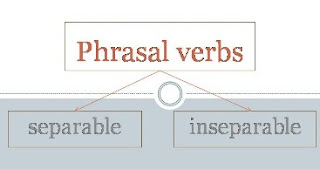
TYPES OF PHRASAL VERBS
Separable
When phrasal verbs are transitive (that is, they have a direct object), we can usually separate the two parts. For example, "look up" is a separable phrasal verb. We can say: "look up the word" or "look the word up".
However, if the direct object is a pronoun, we have no choice. We must separate the phrasal verb and insert the pronoun between the two parts:
Look up the word.
Look the word up.
Look it up. (It's incorrect to say: Look up it).
Inseparable:
However, if phrasal verbs are intransitive (that is, they don't have a direct object), we can't separate them.
Ex: I want my marks to go up.
Sometimes it's not easy to know whether they are separable or inseparable. If you are not sure, use a noun (or noun phrase) and don't separate the phrasal verb. You'll be always right that way! ;)
Here you have a website where you can look up the definition of the phrasal verbs, as well as the type (separable or inseparable)
PHRASAL VERBS

What is a phrasal verb??
It's the combination of a verb + a particle (preposition or adverb) resulting in a new word.
The meaning of that new word is different from the two separate ones.
Examples:
1. He'll work hard to pass the exams.
2. He'll work out what the manual says.
Have a look at this lesson online
In class we worked mostly with phrasal verbs with LOOK, why don't you do the following exercises to practise a little bit more??
Exercise 1
Exercise 2
Subscribe to:
Posts (Atom)